El HEUFT sonic para la detección de presión

El HEUFT sonic para la detección de presión

HEUFT Magnetic Tracking

- the high-tech message in a bottle

It is a known fact that the quality of carbonated drinks deteriorates drastically when carbon dioxide is allowed to escape. Even the slightest damage to the bottle´s finish (which often cannot be seen at first glance) leads to a gradual loss in carbon dioxide. The flavour is impaired and the consumer is left with a bad impression of the product.

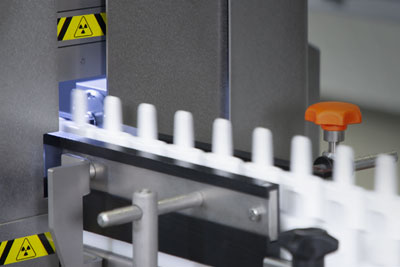
The HEUFT sonic pressure detector has been in service for some years now to detect such containers. This device is able to detect pressureless containers, within the stream of production, with a non-contact inspection method, in lines filling up to 80,000 b/h. They can be separated from production by means of the proven HEUFT rejection systems.

Its functional principle was inspired by music:
the sound of a drum changes, when the tension of the drumhead is altered.

In our case the metallic crown cork of the bottle is the drum and the tension of the drumhead depends on the internal pressure of the bottle. However, the drum is not struck mechanically; it is struck by short electromagnetic pulses. This leads to a mechanical deflection of the closure and it then oscillates in its characteristic waveform.
A microphone records this, amplifies it electronically, filters and analyses it. On the basis of these results the internal pressure can be determined.

However, the waveform also depends on other parameters:

  • closure material (drumhead material)
  • force applied by the closer head (drumhead tension)
  • finish shape of the bottle (shape of the drum´s hollow space)
  • fill level of the bottle (size of the drum´s hollow space)

In order to take all these parameters into account a relative measuring method is necessary. The pitch of the bottles is compared and bottles that sound faulty (= pressure not within the norm) are detected. In other words different drums are compared and those that sound bad are separated.
In music semitones only sound harmonious when they are surrounded by the right sounds. In the same way bottles can have "off key" crown corks, which can only be correctly evaluated when a knowledge of their surroundings is available.

This is the exact point where the development of information transfer via magnetic tracking starts. The HEUFT O2 control after the filler checks the waveform of the closure immediately after the filling process in order to detect bottles with an oxygen content which is too high. At this point the internal pressure of the bottle is nearly the same as the external one. The nominal pressure builds up later (especially during pasteurizing).

The information from this first measurement has to be carried container-related along the bottling line. A conventional container tracking method over multi-lane sectors, for example through a pasteurizer, is impossible. For this reason the magnetic characteristics of the closure are again used - this time as a disk. The results of the first measurement at the HEUFT O2 detection module is encoded on the closure and read out after the pasteurizer at the HEUFT sonic detector. Now we have two measuring results for the same bottle. If the bottle has been correctly sealed the waveform differs due to the varying pressure at the two measuring positions. However, faulty bottles do not change the tone, as their internal pressure cannot rise. Compared to single point measuring a considerable improvement is possible by storing data via magnetic tracking and the analysis of two results taken at different points.


buscar »


noticias » noticias

service around the clock » service around the clock Please click on the circle in order to receive more information about the respective subsidiary.

multimedia »

multimedia
» pix HEUFT <i>magnetic tracking</i>: - el high-tech mensaje en botellaHEUFT magnetic tracking: - el high-tech mensaje en botella HEUFT <i>magnetic tracking</i>: - el high-tech mensaje en botella


perfil » perfil HEUFT SYSTEMTECHNIK GMBH es el líder tecnológico de aseguramiento de la calidad en la producción de alimentos y bebidas. Innovamos constantemente en soluciones automáticas para lograr una inspección sostenible de la calidad de los...

explore HEUFT » explore HEUFT El nuevo sitio web de HEUFT combina información comprensiva sobre todos nuestros productos, sus funciones con un valor añadido de entretenimiento. Tenemos videos y otros contenidos multimedia que ilustran la operación de los desarrollos...

Catálogos » Catálogos Los nuevos catálogos HEUFT publicados proveen información detallada sobre nuestros productos y servicios. Aquí están disponibles para descargar en diferentes idiomas.

link del producto » link del producto
productos bebidas »
» Inspeccción de cajas de retorno
» Clasificador de botellas
» Inspección de Botellas Vacías
» Inspección de Latas Vacías
» Gestión de llenado
» Inspección de envases llenos
» Servicios
» Inspección de objetos extraños XA
» Inspección de objetos extraños XL
» Inspección de objetos extraños XO
» Inspección de fugas en envases de plástico
» Inspección de fugas en envases de cartón
» Ultrasonidos
» Máquina etiquetadora
» Etiquetadora auto-adhesiva
» Etiquetadora wrap-around
» 2 in 1 labeller
» Inspección final de envases
» Inspección de cajas llenas
» Rechazos de envase
» Rechazos de caja
» Sistema de control en el Transportador
» Transporte de envases
» Listado IT
productos alimentación »
» Inspección de envases vacíos
» empty mould inspection
» inspección de envases llenos
» inspección de objetos extraños XAC
»  inspección de objetos extraños XT
» Integrity Check
» inspección de fugas en envases de plástico
» máquina etiquetadora
» etiquetadora auto-adhesiva
» inspección de cajas llenas
» sistema de control en el transportador
» listado IT
productos sanitario »
» Inspector de Botellas Vacías
» Inspección de envases llenos PH
» Inspección de envases llenos
» Inspección de producto lleno
» Latas de Spray -inspección de nivel de llenado y alineador
» Inspección de fuga en envases de plástico
» Detección de Objetos Extraños
» Inspección final del producto
» Inspección exterior del envase
» Rechazo de envases
» Rechazo de caja